Short answer
Answer engines summarise sources instead of only listing them, so being retrievable and quotable now matters as much as ranking. The practical response is clearer entity information, question-shaped content and accurate structured data — not a new set of tricks.
Key takeaways
- A result page is turning into a synthesised answer with citations attached.
- Retrievability — clean structure, clear entities, unambiguous facts — is the new prerequisite.
- Brand and non-brand demand start to diverge; measure them separately.
- Nobody can guarantee an AI citation. Anyone selling that is selling a guess.
For twenty-five years the deal was simple. You typed a query, you got ten links, and the job of a marketer was to occupy one of them. The interface trained an entire industry to think in positions.
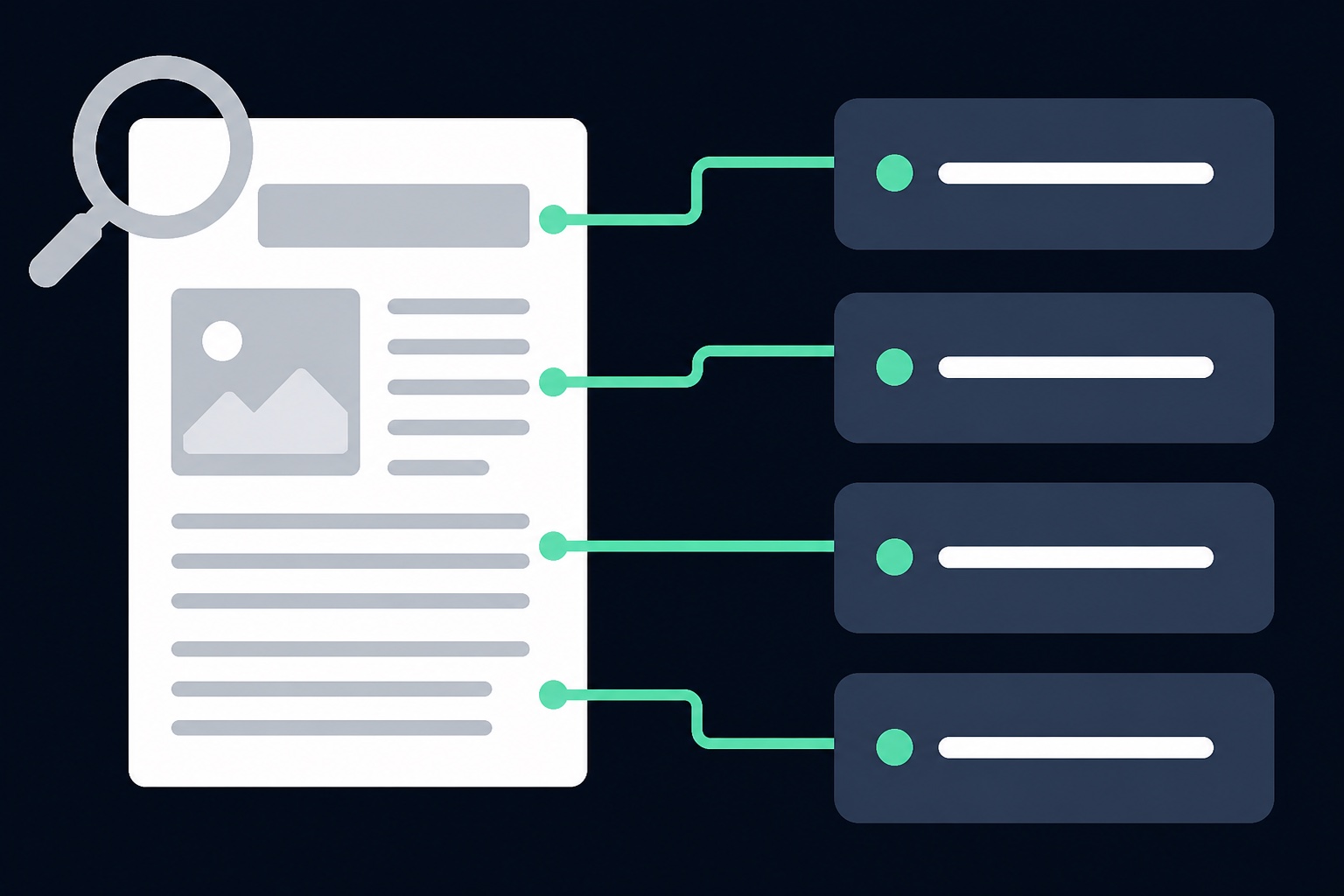
That interface is being replaced in front of us. AI Overviews, assistant answers and chat-first search all do the same thing: they read a set of sources, compose a response, and attach citations to it. The user reads the answer. Sometimes they click. Often they do not.
What actually changed
It is tempting to treat this as a catastrophe or as nothing at all. Both are wrong. Three things genuinely changed, and they are worth stating precisely.
- 01The unit of competition moved from the page to the passage. A model retrieves and quotes the part of your page that answers the question, not the page as a whole.
- 02Ambiguity became expensive. If your business facts are inconsistent across your site, your profile and third-party directories, a system synthesising an answer has no reason to trust any of them.
- 03Informational traffic and commercial traffic began to behave differently. Questions that used to earn a click now get answered in place. Queries with intent to hire, book or buy still send people to a website.
Retrievability is the new table stakes
Retrieval systems reward content that is easy to parse and hard to misread. That is less exotic than it sounds — it is mostly the discipline good technical SEO always asked for, applied more strictly.
- State the answer near the top of the page, in plain language, before the supporting detail.
- Use headings that match how a person would ask the question, not internal jargon.
- Keep facts — name, address, hours, services, pricing model, service area — identical everywhere they appear.
- Mark up entities with structured data so relationships are explicit rather than inferred.
- Cite sources and date your content. Freshness and provenance are signals a synthesiser can use.
A content shape that works
The format that survives this transition is boring and effective: question, concise answer, detailed explanation, evidence, related questions. It reads well for a human skimming on a phone, and it gives a retrieval system a clean unit to lift.
<h2>What does technical SEO cost?</h2>
<p class="answer">
  Most engagements price on scope and site size rather than a flat rate.
  A one-off audit is typically a fixed fee; ongoing work is retained monthly.
</p>
<!-- supporting detail, ranges, what changes the number -->
What to measure now
If a share of informational queries stops producing clicks, click-through rate becomes a noisier signal than it used to be. Separate your reporting so you can see the shift instead of arguing about it.
- Split brand and non-brand queries in Search Console and track them independently.
- Watch impressions against clicks — rising impressions with flat clicks is the signature of answer-in-place.
- Track assisted conversions and direct traffic; answer engines create demand they do not always attribute.
- Keep an eye on the queries that still convert. They are usually transactional and still click through.
The businesses that do well here are not the ones chasing the algorithm. They are the ones whose information was already true, consistent and well organised.
The honest summary
Answer engines raise the floor on quality and lower the tolerance for sloppiness. If a business has a fast, well-structured site, a maintained profile, consistent facts and content that genuinely answers questions, it is positioned for this. If it does not, the fix is the same work that was already overdue.
Related questions
- Is SEO dead because of AI search?
- No. The mechanics of being crawled, indexed, understood and trusted still apply — answer engines depend on them. What is fading is the assumption that a ranking automatically equals a visit.
- Can you guarantee my business gets cited by an AI assistant?
- No, and neither can anyone else. There is no submission process or verified ranking factor. You can meaningfully improve the odds through clear entities, accurate structured data and genuinely useful content, but a guarantee would be fiction.
- Should we block AI crawlers?
- It depends on your business model. Publishers with licensing leverage may choose to. Most local and service businesses want to be findable, and blocking retrieval removes them from surfaces where customers are already asking questions.
Sources
Want this applied to your business?
We'll look at where you stand today and what the highest-impact next move actually is.